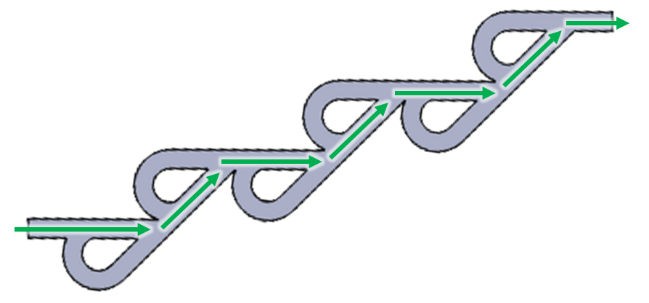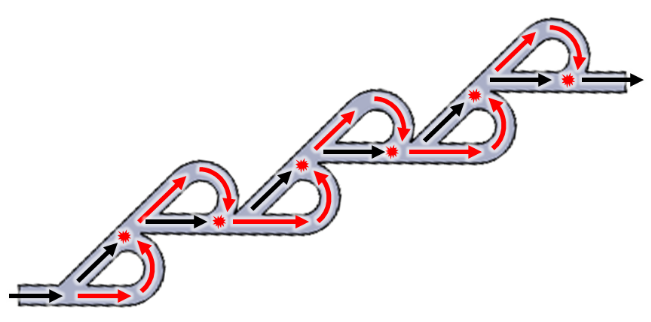

Conventional self-acting valves in reciprocating compressors repeatedly open and close, causing mechanical impacts, wear, and fatigue. Tesla valves offer a concept without moving components. Their specially designed flow channels produce different flow resistances depending on the flow direction, allowing preferential flow without mechanical closing elements. The NoMoVal (No Moving Parts Valve) project investigates whether this principle can be applied to reciprocating compressors to improve operational reliability and potentially reduce maintenance requirements.
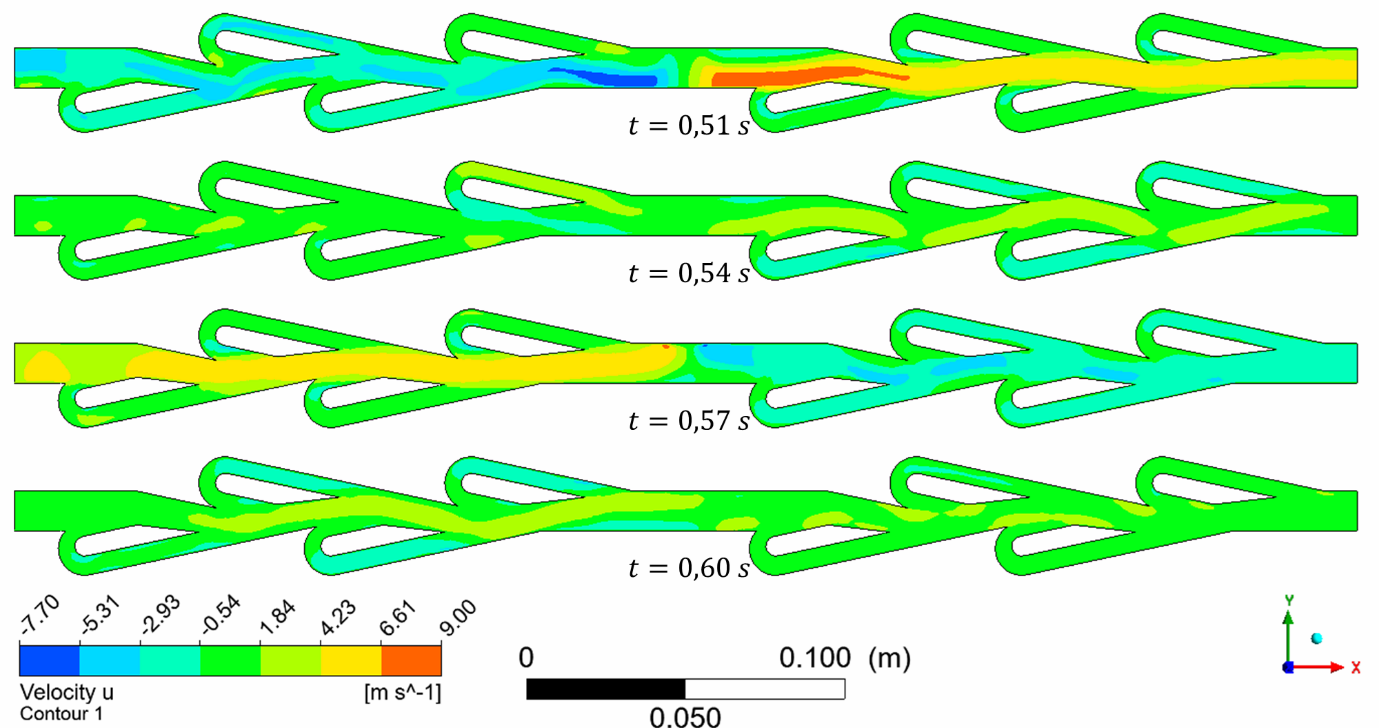
The research uses Computational Fluid Dynamics (CFD) to investigate the behaviour of Tesla valves under steady and pulsating flow conditions. A two-dimensional numerical model comprising two oppositely oriented Tesla valve sections was developed, with the periodic piston motion represented by a time-dependent velocity boundary condition. The simulations examine how different working gases (air, hydrogen, and CO₂), operating pressures, and compressor rotational speeds affect the resulting flow rectification. The results demonstrate that a directed net gas flow can be generated from a purely oscillating flow without moving valve components.
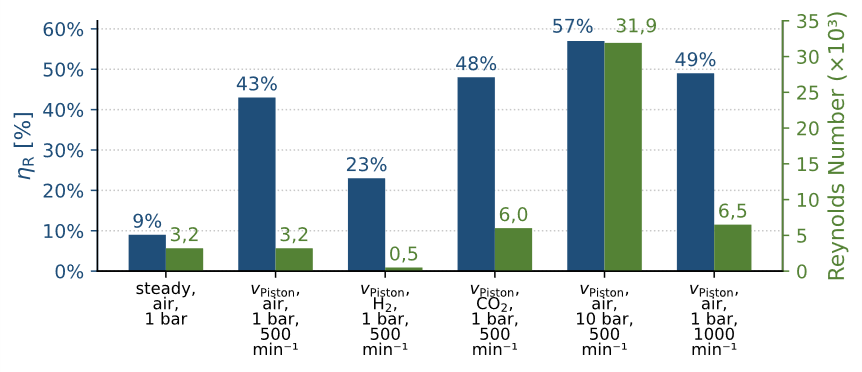
Under reference conditions with air at 1 bar and 500 rpm, the volumetric rectification factor rose from 9% under steady flow to 43% under pulsating flow. Increasing the operating pressure to 10 bar raised the rectification factor to 57%, whereas hydrogen showed a considerably lower value of 23%. However, significant reverse flow persisted across all investigated configurations. These findings demonstrate the potential of Tesla valves for passive flow rectification, but their suitability as replacements for conventional compressor valves has not yet been established. Further research should focus on geometric optimisation, three-dimensional modelling, and performance under realistic compressor pressure differences.