
EFRC R&D Project ‘Constrained layer damping for Small bore side branch connections’: Material selection and testing in lab and field to evaluate the effectiveness of CLD solutions.
Executed by TNO
Fatigue failure of SBC’s is a well-known failure mode in reciprocation compressor systems. High vibrations are often observed late, during commissioning of the system, at which point the implementation of conventional mitigation techniques such as welded braces and reinforcement plates is cumbersome. Constrained layer damping (CLD) can be an effective and easy to use solution to reduce vibrations at small bore branch connections (SBC’s).
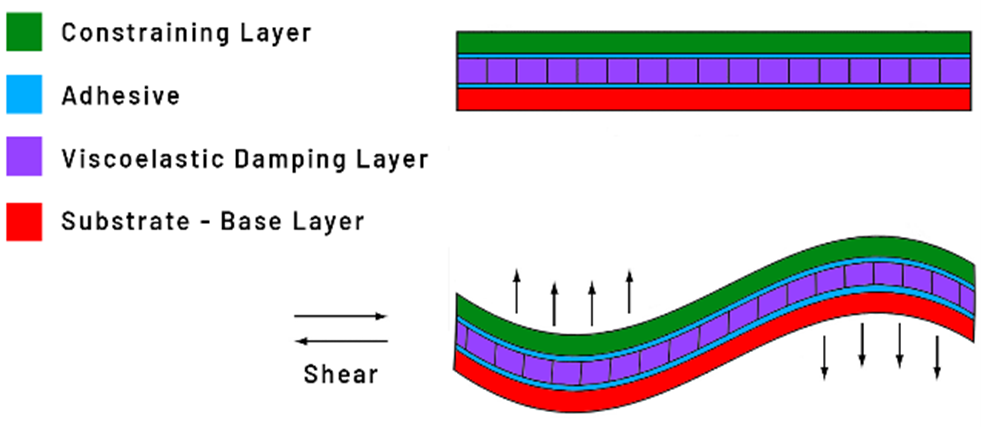
CLD is a combination of three different layers that are held together; a base layer (the side branch), a viscoelastic damping layer and a constraining layer. The shear that is generated due to pipe vibrations and transferred to the viscoelastic layer creates additional damping due to the characteristics of the viscoelastic material.
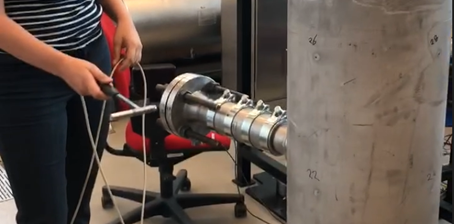
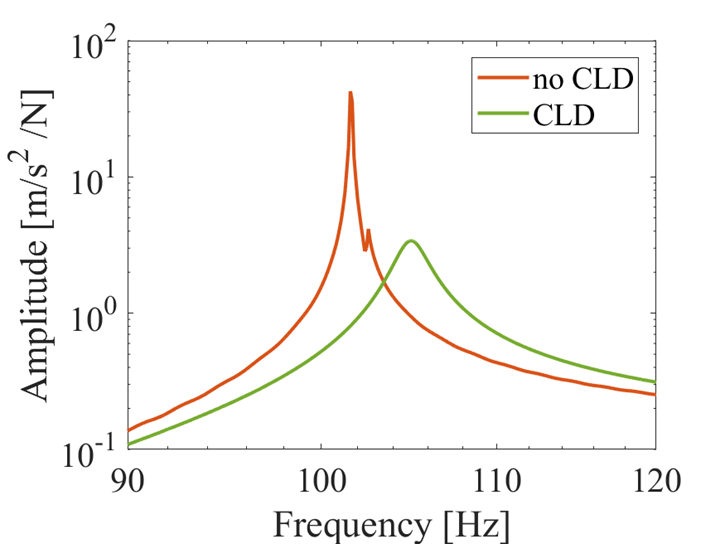
At the lab, a test setup was created in which several CLD geometries were tested. The tests showed that CLD can be highly effective in introducing additional damping to a side branch connection. A damping reduction up to 18 times was achieved for specific layouts. Subsequently, a detailed Finite Element model of the test setup was created. This included the non-linear properties of the viscoelastic material. The simulation results align very well to the test results at the resonance frequency.
A field test was executed at a refinery where several SBC’s of an existing reciprocating compressor system experienced high vibration levels. At each location with elevated levels, CLD was installed and its effectiveness was evaluated with vibration measurement. The observed beneficial effect of the CLD was depending on the geometry and circumstances at which it was applied. It was observed that at increased temperatures (>100 ⁰C) the viscoelastic material deteriorated quickly, both in damping performance as well as in terms of material integrity.
To enable the use of CLD at higher temperatures, several viscoelastic materials have been evaluated. A Dynamic Mechanical Analysis (DMA) was executed for each material at elevated temperatures. With this test the damping properties of the material can be determined for a wide frequency range. The resulting data is used to create a representative material model which can be used in Finite Element Modeling to predict the effectiveness of CLD at specific geometries and temperatures.