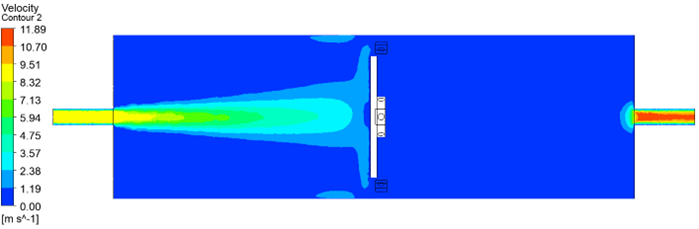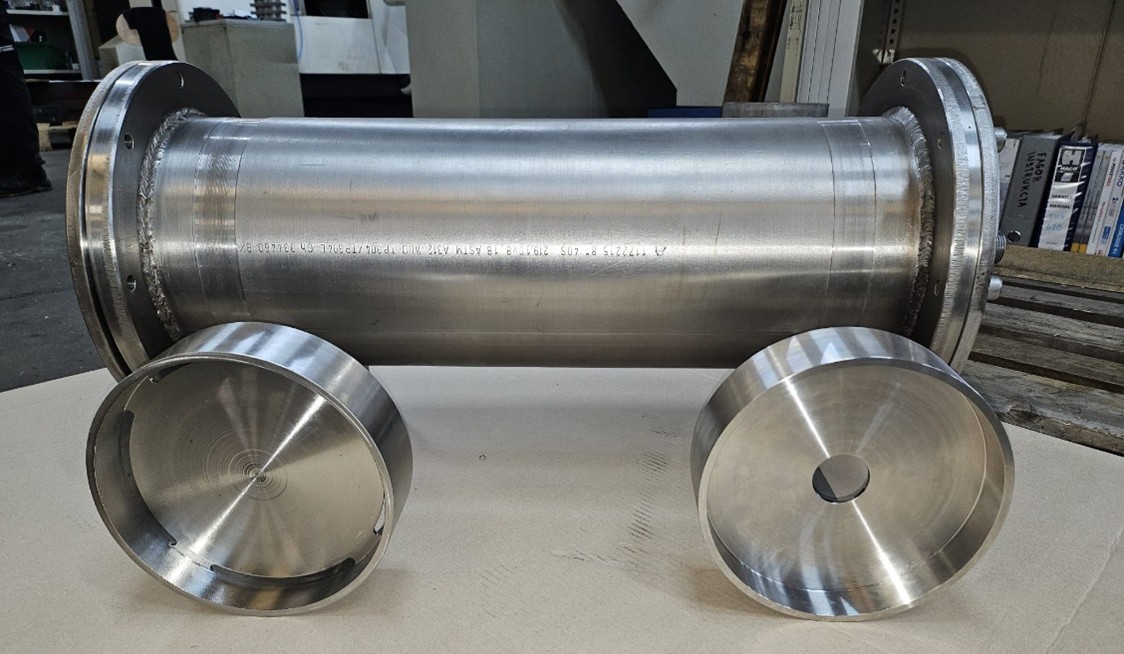

New passive pulsation damper design project concerned simulation and experimental research on a new idea of pulsation damper design, which consists of a body with an internal baffle (plate) placed perpendicularly to the gas flow axis and partly obscuring the shortest gas flow path. A plate is located in the axis of the gas flow in the body, curving the gas flow path, to enable damping of pulsations in an acoustic way by wave reflection, and at the same time it creates a gap between a baffle and a body that enables damping of pulsations by throttling the gas flow. Acoustically, this solution should be identical with a typical baffle damper, but the project results showed differences in pulsation dampening in favour of a new solution.
The project was divided into two main parts including numerical simulations CFD, and experimental tests. First stage focused on confirmation of the method of suppressing pressure pulsations by visualizing the gas flow path, change in the fluid trajectory, reflection on the baffle and plate, and creation of flow vortices, as well as calculating the pressure drop on the tested gas pulsation dampers. The second part of the project’s main objective was to check the pulsation damping possibilities of a new damper design with a range of different baffle variants (plate, conical, spherical) in comparison to the well-known damper constructions.
The research results proved the existence of a direct impact of the pressure wave along the damper axis, and the introduction of an axial plate eliminates its direct transfer to the damper outlet and improves its parameters. In addition, the results clearly indicated that improving damping by increasing throttling may simultaneously have a negative effect on the pressure amplitude generated by the compressor itself. The above assumptions were the basis for developing a new shape of the damper baffle with a significant reduction in the throttling value, and therefore no additional pressure increase in the compressor, while achieving damping with better parameters than in the case of the classic baffle solution.